The data centre industry has been debating raised floors for two decades. Every few years, someone declares the raised floor dead. Overhead cooling is the future, they say. Direct-to-chip is the future. Liquid immersion is the future. And yet, the majority of operating data centres worldwide still run on raised floor cooling.
The raised floor is not dead. But it is not the right answer for every facility either.
This post compares raised floor and overhead cooling approaches based on what actually matters to operations teams: cooling performance at the rack inlet, flexibility for changing workloads, capital and operating costs, and compatibility with high-density deployments. No vendor agenda. Just the tradeoffs.
How Each Approach Works
Raised Floor Cooling
In a raised floor environment, the cooling system pushes cold air into a pressurised plenum beneath the floor. That air rises through perforated floor tiles positioned in front of the server racks (typically in the cold aisle). Servers draw the cold air in through their front intakes, pass it over the internal components, and exhaust hot air out the rear into the hot aisle. The hot air returns to the CRAC/CRAH units at room level.
The raised floor acts as an air distribution system. The tiles are the delivery points. The plenum is the duct.
Overhead Cooling
Overhead cooling eliminates the raised floor entirely. Cooling units mount above or beside the racks, delivering cold air downward or horizontally directly to the rack intakes. In some configurations, chimney-style exhaust ducts capture hot air from the rack tops and route it directly back to the cooling units.
The floor is a slab. The air distribution happens through overhead ductwork, ceiling plenums, or close-coupled cooling units mounted at the row or rack level.
Where Raised Floors Still Win
Established Infrastructure
Thousands of operating data centres were built on raised floors. The plenum, the tiles, the CRAC units, and the cable routing all exist. Converting these facilities to overhead cooling would require ripping out the floor, redesigning the cooling distribution, rerouting cabling, and potentially modifying the structural slab. For a facility with years of remaining useful life, that conversion rarely makes financial sense.
For these environments, the question is not “should we have a raised floor?” The floor is already there. The real question is: “how do we get the best performance from the raised floor we have?”
The answer involves three things: proper tile selection and placement, blanking panel coverage in every rack, and containment where density justifies it. A raised floor facility with these three elements performs at or near the efficiency of an equivalent overhead system.
Flexible Air Distribution
Raised floor tiles can be rearranged without tools in most configurations. Need more airflow in a specific zone? Swap solid tiles for perforated ones. Running a new high-density row? Install high-output directional tiles in front of those racks. Decommissioning an aisle? Replace perforated tiles with solid ones to redirect airflow elsewhere.
This flexibility is a significant advantage in facilities with changing workloads or phased buildouts. Overhead systems, once installed, are harder to rebalance. Ductwork is fixed. In-row cooling units are bolted to specific positions. Changing the cooling distribution in an overhead system usually means moving hardware, not just swapping tiles.
Sub-Floor Cable Management
Many raised floor facilities use the plenum for both airflow and cable routing. While this is technically a compromise (cables in the plenum obstruct airflow), it is a compromise that has been well-managed for decades. Properly routed cables with overhead cable trays or under-floor cable troughs minimize the airflow impact while providing convenient cable access.
Overhead systems force all cabling to the ceiling or overhead trays, which can create congestion in dense environments and makes cable tracing and replacement more difficult.
Where Overhead Cooling Wins
High-Density Deployments
This is overhead cooling’s strongest case. In a raised floor environment, the cooling capacity at any given rack is limited by the tile output (measured in CFM, cubic feet per minute) and the plenum pressure. Standard perforated tiles deliver 400 to 600 CFM in a well-pressurised plenum. High-output directional tiles can push this higher, but there is a practical ceiling determined by the plenum depth and static pressure.
For racks drawing 20 kW or more (common in GPU and AI workloads), the airflow volume required at the rack inlet can exceed what a floor tile can deliver. Overhead cooling or close-coupled row-based cooling places the cold air source closer to the rack and eliminates the plenum bottleneck.
If your facility is deploying high-density racks (15+ kW per rack consistently), overhead or row-based cooling is likely the better architecture for those zones. This does not mean the entire facility needs overhead cooling. It means the high-density zones do.
New Builds Without Legacy Constraints
For new data centre construction, overhead cooling eliminates the structural and cost requirements of a raised floor. No pedestal system. No floor tiles. No plenum engineering. The slab floor is simpler to construct and less expensive.
New builds also allow the cooling system to be designed from scratch around overhead distribution, which avoids the compromises inherent in retrofitting overhead systems into facilities designed for raised floor operation.
Reduced Leakage
Raised floor plenums leak. Tiles shift over time, creating gaps. Cable cutouts allow air to escape without passing through the tiles. The floor perimeter and column penetrations develop gaps as the building settles. Every leak represents cooling capacity that is lost before it reaches the rack inlets.
Overhead systems have fewer leakage points because the air path is shorter and more contained. Ducted overhead systems in particular can achieve tighter air delivery with less waste.
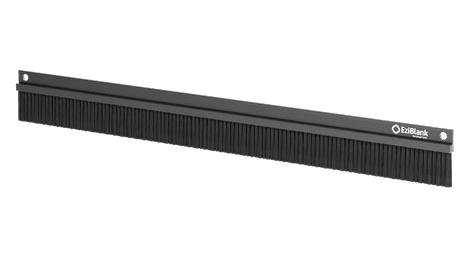
That said, raised floor leakage is manageable. Brush grommets seal cable pass-throughs. Proper tile maintenance closes edge gaps. And containment reduces the impact of residual leakage by creating a pressurised cold zone that compensates for minor air losses.
The Hybrid Reality
Here is what the raised-floor-is-dead narrative misses: most facilities in 2026 are not choosing one or the other. They are running hybrid cooling architectures.
A common configuration uses the raised floor for general-purpose compute (10 to 15 kW per rack) and adds in-row or overhead cooling for high-density zones (20+ kW per rack). The raised floor handles the base load. The supplemental cooling handles the peaks.
This hybrid approach lets existing facilities scale to higher densities without abandoning their raised floor investment. It also provides redundancy: if the overhead units need maintenance, the raised floor system continues delivering baseline cooling to the affected zone.
The Tile Variable That Most People Ignore
In raised floor environments, tile selection and placement have a larger impact on cooling performance than most teams realise.
A standard perforated tile with 25% open area delivers a predictable volume of air based on the plenum pressure. But that air exits the tile in all directions. Much of it never reaches the rack inlets. It spills into the aisle, mixes with room air, or gets pulled sideways by adjacent racks.
Directional airflow tiles solve this by controlling the air exit angle. They push the air toward the rack face rather than letting it dissipate. The result is more usable cooling at the rack inlet from the same plenum pressure. In many facilities, switching from standard perforated tiles to directional tiles delivers a measurable improvement in inlet temperature consistency without any changes to the cooling units.
Tile placement matters too. Tiles placed too far from the rack face lose effectiveness. Tiles placed in the hot aisle waste cooling capacity entirely. Configuring tile dampers for high-density zones allows fine-tuned airflow delivery that matches the actual heat load of each rack position.
Making the Decision
If you are operating an existing raised floor facility with years of remaining life, the answer is almost always to optimise what you have: better tiles, complete blanking panel coverage, and containment where density justifies it. Converting to overhead cooling is a capital project that rarely delivers enough additional benefit to justify the disruption and cost.
If you are building new or deploying high-density zones (15+ kW per rack), overhead or row-based cooling should be part of the design. The airflow delivery is more direct, more controllable, and better suited to the thermal demands of modern GPU and AI workloads.
If you are somewhere in between (existing facility with growing density), the hybrid approach is the pragmatic choice. Keep the raised floor for general compute. Add targeted overhead cooling for the racks that need it. And make sure the airflow management fundamentals (blanking panels, tile selection, sealing) are solid across the entire facility.
Contact EziBlank to discuss floor tile solutions and airflow management for your facility.