Edge Data Center Cooling: Airflow Management for Smaller Footprints
Edge data centres operate under different constraints than traditional facilities. They are smaller, often unmanned, frequently located in commercial buildings or repurposed spaces, and rarely have raised floors or dedicated cooling plants. But the physics of airflow management are the same regardless of scale: hot air recirculates when rack spaces are left open, and equipment overheats when cooling air cannot reach the intake.
The difference at the edge is that there is less margin for error. A 10-rack edge site with no redundant cooling cannot afford hot spots. EziBlank provides blanking panels, brush panels, and airflow management products sized for these smaller environments.
Edge sites and server rooms face the same airflow challenges with less cooling headroom. For strategies tailored to smaller footprints, see edge data center cooling.
What Makes Edge Cooling Different
Enterprise data centres are purpose-built. They have raised floors, dedicated CRAC or CRAH units, hot and cold aisle containment, and operations teams on site around the clock. Edge data centres have few or none of these advantages.
A typical edge deployment might consist of 4 to 20 racks in a converted office space, a retail backroom, a telecommunications exchange, or a modular container. Cooling is often provided by split system air conditioning, in-row cooling units, or overhead precision cooling rather than an underfloor plenum system.
These environments face specific airflow challenges. Without raised floors, cold air cannot be delivered from below through perforated tiles. Without containment, hot and cold air mix freely in the room. Without on-site staff, blanking panels that fall out or get removed during maintenance may not be replaced for weeks or months.
Despite these constraints, the airflow management principles are the same. Seal open rack spaces. Separate hot and cold air as much as possible. Direct cooling air to the rack intakes. The products just need to work in tighter spaces with simpler cooling systems.
As compute moves closer to the user, airflow management at the edge becomes a growing priority. See cooling solutions for edge data centers.
Select the Right Airflow Panels for Your Compact Rack Configuration
-
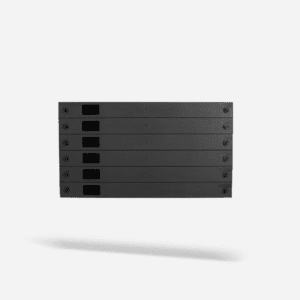
19″ 6RU Universal Blanking Panel
Price range: $186.00 through $200.00 AUD -

21″ 10SU Universal Blanking Panel for ETSI Rack
Price range: $240.00 through $250.00 AUD -
23″ 6RU Universal Blanking Panel
$250.00 AUD -
19” 6RU Standard Blanking Panel
Price range: $145.00 through $186.00 AUD -
New 19″ 6RU Universal Blanking Panel
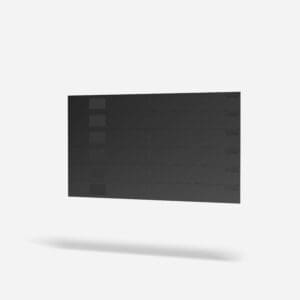
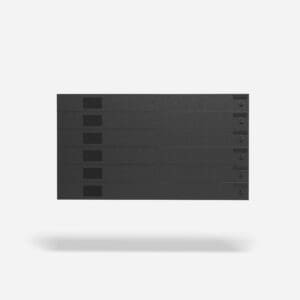
Blanking Panels for Edge and Server Room Environments
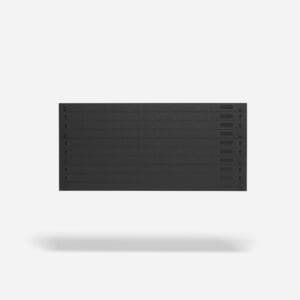
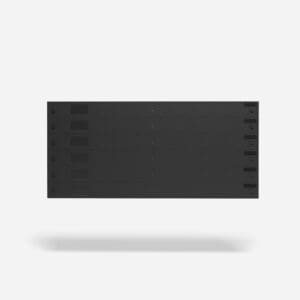
Open rack spaces are the single largest source of cooling inefficiency in edge sites, just as they are in enterprise data centres. A 42U rack with 15U of open space allows a significant volume of hot exhaust air to loop back to the front of the rack, raising inlet temperatures and overworking the room cooling system.
Server room blanking panels from EziBlank seal these gaps with the same tool-free, snap-on design used in enterprise environments. The panels are modular (6RU blocks that snap apart into 1U segments), reusable, and made from flame-retardant ABS rated to UL94-V0.
For edge sites where racks change configuration infrequently, the universal blanking panel is the best default choice. It fits square-hole, round-hole, and threaded-hole rails, which covers virtually every rack type an edge deployment might use. This eliminates the risk of ordering panels that do not match the rack hardware.
For sites with multiple rack sizes or non-standard cabinets, visit the blanking panel comparison to match panel width and mounting type to your specific racks.
Brush Panels for Cable Management
Edge sites frequently have denser cabling relative to their rack count than enterprise environments. A single rack might support networking, compute, storage, and telecommunications connections, with cable bundles entering from the top, bottom, and rear.
Where cables pass through unused rack spaces, they create the same airflow bypass as an empty U-space. 1RU brush panels solve this by allowing cables to pass through while the brush bristles seal around the cable bundle and block air recirculation.
Brush panels are particularly useful in edge environments where cable routing is less structured than in enterprise facilities. They accommodate irregular cable bundles without restricting access for maintenance or reconfiguration.
Edge deployments are growing alongside AI workloads. For airflow management strategies in constrained spaces, see edge cooling solutions.
Cooling Strategies Without Raised Floors
Most edge data centres do not have raised floors. Cold air is delivered from wall-mounted, ceiling-mounted, or in-row cooling units rather than from an underfloor plenum. This changes the airflow pattern but does not eliminate the need for airflow management.
In non-raised-floor environments, the following strategies improve cooling effectiveness:
Face racks toward the cooling source. Position racks so that the cold aisle faces the air conditioning output. This delivers cold air directly to the rack intakes without mixing with hot exhaust air.
Seal all open U-spaces. Blanking panels are even more important in non-raised-floor environments because there is no pressurised plenum to push cold air through the racks. Every open U-space reduces the pressure differential that drives air through the equipment.
Use in-row cooling where possible. In-row units sit between racks and deliver cold air directly into the cold aisle. They are more efficient than wall-mounted units for rack counts above 6 to 8, because the cooling air does not have to travel across the room before reaching the racks.
Manage exhaust paths. Hot air leaving the rear of the racks needs somewhere to go. If it accumulates behind the racks and recirculates, inlet temperatures rise regardless of how much cooling the room unit provides. Leave adequate clearance behind racks and position return air paths so hot air flows directly back to the cooling unit intake.
Many of the same products and principles apply to edge data centres and remote server closets. For a focused guide on cooling smaller server environments, see the edge cooling page.
When to Consider Containment at the Edge
Full hot or cold aisle containment is not always practical in edge environments. The rack count may be too small, the ceiling height too low, or the room layout too irregular for containment panels to form a complete enclosure.
However, partial containment can still deliver meaningful results. End-of-row curtains or panels prevent cold air from escaping the ends of short rows. Overhead baffles above the racks prevent hot air from rolling over into the cold aisle. Even simple measures like positioning racks in opposing rows (cold aisle facing cold aisle) create a natural separation between hot and cold airstreams.
For edge sites where standard products do not fit the space, EziBlank offers tailor-made solutions for non-standard environments with custom panel dimensions built to specific room layouts.