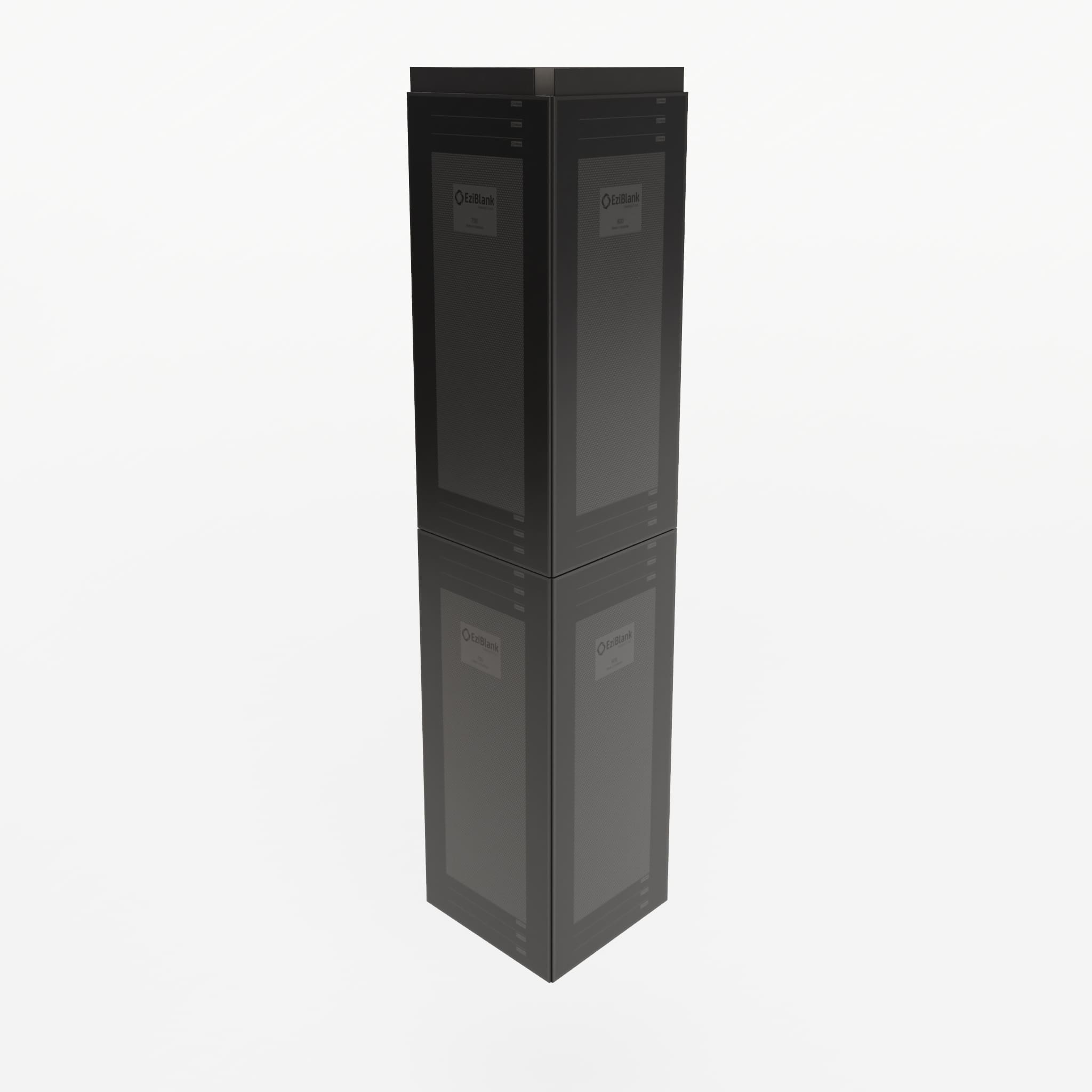
Blanking Panel ROI Calculator: Estimate Your Energy Savings
Every open rack unit in your data centre leaks cooling energy. Blanking panels cost a fraction of the energy they save, but quantifying that saving is what gets the purchase approved. This page breaks down the real financial return of blanking panel deployment and gives you the numbers to build a business case your finance team will sign off on.
ROI Calculator
Estimate your energy savings from blanking panel deployment
Estimates are based on industry-standard assumptions for blanking panel airflow improvement. Actual savings depend on facility design, current airflow management state, cooling infrastructure, and local energy costs. Prices shown in AUD and converted at approximate rates. Contact EziBlank for a facility-specific assessment.
Why Blanking Panels Deliver Measurable ROI
Open rack spaces allow hot exhaust air to recirculate back into the cold aisle. When this happens, CRAC and CRAH units work harder to maintain inlet temperatures, fans spin faster, and energy consumption climbs. The result is wasted cooling capacity and inflated electricity bills.
Blanking panels eliminate this recirculation by sealing unused U-spaces. The effect is immediate: inlet temperatures stabilize, cooling units run more efficiently, and the facility’s Power Usage Effectiveness (PUE) improves.
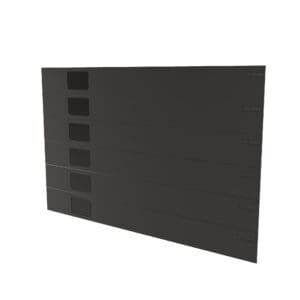
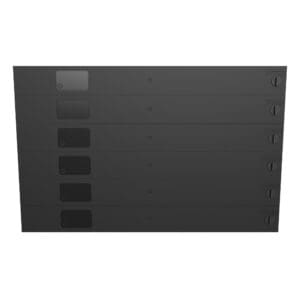
The cost of blanking panels is low relative to almost any other data centre infrastructure investment. A single 6RU EziBlank panel costs between $145 and $250 AUD depending on the model. A typical 42U rack requires two to three panels. Compare that to the thousands of dollars per rack per year that poor airflow management adds to cooling costs, and the payback period is measured in weeks, not years.
shop our range
-
19″ 6RU Universal Blanking Panel
Price range: $186.00 through $200.00 AUD -

21″ 10SU Universal Blanking Panel for ETSI Rack
Price range: $240.00 through $250.00 AUD -
23″ 6RU Universal Blanking Panel
$250.00 AUD -
19” 6RU Standard Blanking Panel
Price range: $145.00 through $186.00 AUD -
New 19″ 6RU Universal Blanking Panel
The Numbers Behind the Savings
The financial return from blanking panels comes from three sources: reduced cooling energy consumption, extended equipment lifespan, and deferred cooling infrastructure upgrades.
Cooling energy reduction. Industry research consistently shows that proper airflow management, including blanking panels, can reduce data centre cooling energy by 10% to 25%. For a facility spending $500,000 per year on cooling, even a 10% reduction delivers $50,000 in annual savings. The blanking panel investment for a 200-rack facility (roughly 400 panels at $186 each) totals approximately $74,400, meaning the payback period falls under 18 months from cooling savings alone.
PUE improvement. PUE measures total facility power divided by IT equipment power. A PUE of 2.0 means the facility uses as much power on cooling and overhead as it does on IT loads. Sealing open rack spaces typically improves PUE by 0.05 to 0.15 points. For a facility with a 2MW IT load, improving PUE from 1.8 to 1.7 saves approximately $175,000 per year in overhead power costs at $0.10/kWh.
Equipment lifespan. Server fans compensate for poor inlet temperatures by running at higher speeds, which increases wear and shortens fan bearing life. Stabilizing inlet temperatures with proper airflow management reduces fan stress and extends the operational life of IT hardware. While this saving is harder to quantify per rack, it compounds across hundreds of servers over a three-to-five year refresh cycle.
Deferred cooling upgrades. Many facilities add cooling capacity to compensate for hot spots caused by poor airflow management. Blanking panels often recover enough cooling headroom to delay or eliminate the need for additional CRAC units, each of which costs $50,000 to $150,000 installed.
How to Calculate Your Facility's ROI
You can estimate your blanking panel ROI with four data points that most operations teams already track.
1. Count your open U-spaces.
Walk your racks or pull data from your DCIM system. Count every empty rack unit across the facility. A 200-rack data centre with an average of 10 open U-spaces per rack has 2,000U of unsealed space.
2. Calculate the panel investment.
Divide the total open U-spaces by 6 (each EziBlank panel covers 6RU). Multiply by the per-panel cost for your chosen model. For example: 2,000U / 6 = 334 panels. At $186 per panel (19″ Universal), that totals $62,124 AUD.
3. Estimate your cooling energy saving.
Take your annual cooling electricity cost. Apply a conservative 10% reduction as the expected saving from sealing all open rack spaces. If your facility spends $400,000 per year on cooling, the estimated annual saving is $40,000.
4. Calculate the payback period.
Divide the panel investment by the annual saving. Using the example above: $62,124 / $40,000 = 1.55 years. After 19 months, the panels have paid for themselves. Every year after that is pure savings.
For facilities with higher cooling costs, more open U-spaces, or older cooling infrastructure running less efficiently, the payback period shortens further. Some operations teams report full payback within six to nine months.
Beyond the Calculator: The Full Business Case
The numbers above cover direct energy savings, but the full business case for blanking panels includes benefits that are harder to assign a dollar figure to.
Thermal compliance. Many colocation SLAs, insurance policies, and internal standards require inlet temperatures within ASHRAE recommended ranges (18 to 27 degrees Celsius). Blanking panels help maintain these ranges without over-cooling the facility. Non-compliance can trigger SLA penalties, insurance complications, or audit findings.
Capacity recovery. Hot spots caused by air recirculation effectively reduce the usable capacity of a data centre. Racks adjacent to unsealed cabinets may be derated or left partially empty to avoid thermal risk. Proper airflow management recovers this capacity without adding floor space or cooling infrastructure.
Audit and certification readiness. Uptime Institute Tier certifications, ISO 50001 energy management, and EN 50600 data centre standards all reference airflow management as a baseline requirement. Blanking panels are the simplest way to demonstrate compliance during audits.
Sustainability reporting. With increasing pressure on organizations to report Scope 2 emissions and energy efficiency metrics, a lower PUE directly supports ESG and sustainability targets. Blanking panels are a low-cost, high-visibility measure that demonstrates operational commitment to energy reduction.
Sample ROI Scenarios
Small server room (10 racks, 80U open)
- Panels needed: 14 (at $186 each) = $2,604
- Estimated annual cooling saving (10% of $30,000): $3,000
- Payback: under 11 months
Mid-size data centre (200 racks, 2,000U open)
- Panels needed: 334 (at $186 each) = $62,124
- Estimated annual cooling saving (10% of $400,000): $40,000
- Payback: approximately 19 months
Large colocation facility (1,000 racks, 8,000U open)
- Panels needed: 1,334 (at $186 each) = $248,124
- Estimated annual cooling saving (10% of $2,000,000): $200,000
- Payback: approximately 15 months
In every scenario, the investment pays for itself within two years, and the panels continue delivering savings for their full operational life with no ongoing maintenance costs.
Ready to Build Your Business Case?
If you have your facility’s rack count and cooling costs, you already have enough data to calculate your ROI. For help with panel selection, quantity planning, or a formal quote, contact the EziBlank team.
To choose the right panel for your racks, see the blanking panel comparison. To understand what proper airflow management looks like across your full facility, explore blanking panels for server racks.
Frequently Asked Questions
What PUE improvement can I expect from blanking panels alone?
Blanking panels typically contribute a 0.05 to 0.15 PUE improvement, depending on how many open U-spaces exist and the current state of airflow management in the facility. Facilities with significant unsealed rack space see the largest gains.
Do I need to seal every open U-space to see results?
No. Even partial deployment delivers measurable improvement. However, every unsealed U-space is a source of recirculation, so the return improves with each additional panel installed. Prioritize racks closest to CRAC return air paths and racks with the highest inlet temperatures.
How long do EziBlank panels last?
EziBlank panels are made from flame-retardant ABS plastic (UL94-V0) and are designed for repeated installation and removal without degradation. There is no defined replacement cycle. Panels typically outlast the racks they are installed in.
Can blanking panels really defer a cooling upgrade?
Yes. Many facilities add CRAC or CRAH capacity to address hot spots caused by poor airflow, not because the facility has genuinely exceeded its cooling capacity. Sealing open rack spaces often recovers enough cooling headroom to delay or cancel planned cooling infrastructure additions worth $50,000 to $150,000 per unit.